
Are you looking for PU$$Ybilities?
Opening April 18, 17:00–19:00
In this second iteration of Pussybilities, Anne-Lise Coste transforms the gallery space into a field of experimentation. The project first unfolded in the architecture of a castle turned Contemporary Art Museum of Haute-Vienne and now reappears in Ellen de Bruijne PROJECTS in a new configuration. This movement from one site to another mirrors the logic of the work itself. Nothing is fixed. Images travel. Objects shift position. Meanings are constantly recomposed.
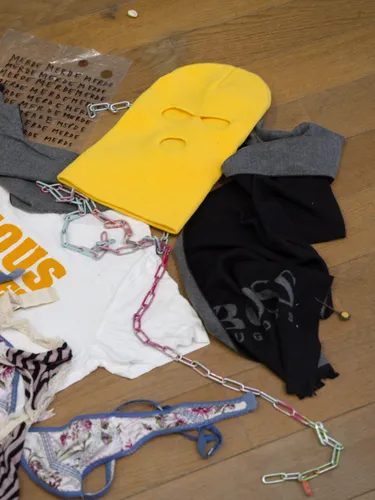
Across the installation, clothing, photographs, collages, printed textiles and neon words create a loose landscape of images and signs. At first glance the space looks almost casual. T-shirts hang on structures, garments appear folded or suspended, photographs show groups of bodies, and collaged figures emerge from cut paper. But slowly another structure appears. The exhibition becomes a stage where bodies circulate even when they are not physically present.
Here the relationship between body and clothing is quietly inverted. Normally clothing covers or carries the body. In Coste’s installation the opposite begins to happen. Garments become surfaces that carry bodies as images. Printed faces, silhouettes and photographic fragments migrate onto fabric. Clothing becomes a support, almost a skin that stores gestures, attitudes and identities. The décor of the exhibition is built out of these traces.
The bodies themselves rarely appear as complete figures. They are cut, cropped, pasted and recomposed. In collages and photographic assemblages, limbs, postures and expressions detach from their original context and reassemble in new constellations. This strategy directly recalls the visual language of Dada photomontage and later feminist collage practices of the 1970s and 1980s. The body is not a stable image but a field of possibilities. It can be multiplied, fragmented and reimagined.
Light plays another role in this choreography of fragments. Neon words punctuate the space with sudden flashes, like signals cutting through the room. Their glow recalls the atmosphere of a dance floor where bodies move, appear, disappear and cross paths. Here the installation stages precisely what Judith Butler named the performativity of gender: the body is never a fixed essence but an act endlessly repeated, a “pussybility” constantly re-enacted in the social rituals of identity. In this environment, language becomes part of the rhythm of the space. The luminous words pulse among the collages, garments and images, activating the installation like beats of light. They echo the movement suggested throughout the exhibition. Bodies in photographs, bodies carried by clothes, bodies cut and recomposed in paper fragments. The neon becomes a kind of visual tempo, guiding the eye and the imagination through the installation, as if the entire space were animated by the invisible motion of bodies passing through it.
Through clothing, images and language, the installation suggests a collective presence that is playful, shifting and open. The garments hint at different bodies that could inhabit them. The collaged figures propose multiple ways of being seen. The neon words speak with irreverence and confidence. Together they sketch a landscape where bodies are not fixed identities but moving potentials.
In Anne-Lise Coste’s world, the exhibition space becomes something close to a dance floor for images. Bodies appear, disappear, fragment and recombine. And somewhere between fabric, paper and neon, new pussybilities begin to take shape.
Text by Anounchka Mbia
